11.17.2009

Tomatoes Were Scary

For hundreds of years western culture believed that the tomato, a member of the nightshade family and relative to the deadly belladonna (above), was poisonous. With a name like Lycopersicon esculentum or "Wolf peach" it was hard to argue against it's bloodthirsty association. It was also believed that eating tomatoes would cause hallucinations and became tied to witchcraft.

Then one day in 1820 Col. Robert Gibbon Johnson of Salem, NJ stood on the steps of the Salem courthouse with a basket of tomatoes. Believed to be an attempt of public suicide, a crowd began to gather around him. Some accounts claim that over 2,000 people attended the event and even the local fireman's band played mourning songs as he began to eat the "poison berries". His doctor feverishly warned him of his foolish decision, claiming that it would turn his blood to acid and end his career after one bite. Much to everyone's surprise the Colonial did not die after eating the bushel and after news of the sensational event spread the tomato industry in America took off.


Foul Play

No idea of what's in store...the hunter marks her prey.

1994 marked the death of sportsmanship. A tragic incident occurred between figure skating star Nancy Kerrigan and the notorious Tonya Harding. After a practice during the U.S. Nationals in Detroit, Kerrigan was attacked. The target: her skating leg, the most essential part of a skater's body. The assault was quickly linked to rival Harding who went on to win the championship the next day. Kerrigan was able to compete in the upcoming olympics only thanks to a young and generous Michelle Kwan.

The attack did not just rattle Nancy. The world was in shock and awe over the now apparent dangers of competition. If something so violent could happen in figure skating, it seemed that no athlete was safe. The sporting world was never the same again. It seemed as if foul play would prevail. Sometimes, like for Nancy Kerrigan, the future can be scary and you don't even know it.

11.16.2009

The 1967 PC Dream

Curious Fear of the Rhinoceros

Before 1515 the last time Europe had seen a Rhinoceros was during the Roman Empire. It was put into the same mythical category as unicorns. In 1515 one arrived in Lisbon as a present from the ruler of Cambay. The Rhinoceros was put into King Manuel's menagerie where he then arranged a fight between it and one of his elephants. He wanted to test an account of Pliny the Elder about how elephants and rhinoceri are bitter enemies. However, during the battle the noise of the crowd startled the rhinoceros and it fled the scene in panic. After this, King Manuel gave the rhinoceros to the Pope for his menagerie. Sadly on the way there the ship containing the rhinoceros was wrecked in a storm and it perished in the depths of the sea.


Although never seeing the rhinoceros, Albrecht Dürer produced a woodcut of the animal from a written account. This representation is a scary interpretation of the animal. It consists of a body made of armor with a scaly texture covering it. Dürer's print was thought to be an accurate representation of the animal up until the 18th century where more rhinoceros were imported to Europe. Scary, huh?

11.10.2009

Kate Chopin Dies From Being Surrounded by New Technology at St. Louis World's Fair

The 1904 St. Louis World's Fair was the mothership of world's fairs. It had been planned as a centennial celebration of the Louisiana Purchase, but it also served as a celebration of new technology. Electric lights had recently been invented and they decorated the grounds head to toe to serve both as illumination and fascination. There were "palaces" devoted to the marvels of technology, such as the Palace of Varied Industries and Palace of Electricity.


The Palace of Electricity

Not only were there gigantic buildings representing modern marvels but there were also celebrations for them such as the transportation day ceremony. The St. Louis World's Fair was one of the first instances where mass amounts of middle class people in the US travelled across state borders just for tourism, remember they did not have planes back then.


The Festival Hall

The fair was a perfect city. A perfect city made from new technology, but also a scary city. So scary that it killed Kate Chopin. On August 20th 1904 Chopin collapsed at the fair due to an overdose of severe oogling at the splendor of technology. Two days later she died. It was a battle between Chopin, a great writer with scary new ideas about a woman's role in society, and the Fair, a supernatural devotion to the future; and as always, technology wins.


11.09.2009

Movies That Got it Right


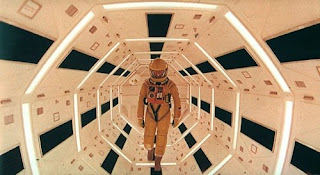
The Stanley Kubrick film, 2001: A Space Odyssey, was released before man even set foot on the moon. Yet the flick was a visionary peek into the future. The movie follows spaceman Dave who is on a mission to Jupiter on a ship controlled by the computer, HAL 9000. HAL tries to take over, sabotaging Dave and killing the other guys on board. Dave realizes that HAL sucks, but I won't spoil the end. What's really important is that almost everything shown in this movie became real. Video chat, flat screen TV's, voice recognition, computers that can play chess, the list goes on. To the people of 1968, the film was simply a science fiction fantasy, but in hindsight it is clear that the movie is a 3 hour crystal ball predicting the future. If this film could so accurately tell the future 33 years before it happened, what other motion pictures could be foreshadowing what is to come?

Think back to the 1999 Disney Channel original Smart House. The directorial masterpiece by Reading Rainbow's LeVar Burton, is about a family who wins a fully programmed computer house that can make their lives better and more efficient. Smart House is controlled by PAT a 50's housewife in a circuitry disguise. Everything is going great until PAT goes crazy and locks the family inside their own home and takes over their lives. Sound familiar?


Hal 9000 [1968]/PAT [1999]

If 2001 could be so right, who's to say that Smart House is too impossible? We should not be so quick to dismiss Hollywood's "wacky" ideas. I would hate to admit to an "I told you so" from Mr. Burton.

The Great Y2K

People living in the ancient world thought about the future cyclically. They thought that times would shift from a golden age to a dark age and eventually recover. People started thinking about the future linearly during the Renaissance. Since then we have been a part of this continuum that gradually advances upwards until it reaches a peak where it can't go any further. At the peak a great disaster will occur, such as the apocalypse. Or like...

Y2K

The main problem facing Y2K was the concern that computer clocks wouldn't be able to rollover from x99 to x000. Somehow this fear sparked apocalyptic theories associated with Y2K like the ones discussed in this video:


Video courtesy of Everything is Terrible!

Of course nothing scary happened on January 1st 2000. It has only been a decade since the great Y2K and the time has definitely given us all better perspective on how stupid it really was.